When producing business cards, brochures, flyers, menus, company profiles, and promotional materials, choosing the right lamination finish can significantly influence the final appearance and durability of the printed product. Matte and gloss lamination are two widely used finishing options, each offering distinct visual characteristics and practical benefits.
For businesses looking for professional digital printing services in Dubai, understanding the differences between matte and gloss lamination helps ensure that printed materials match their branding requirements, intended use, and budget.
Although both finishes apply a protective film over the printed surface, they differ in light reflection, surface appearance, fingerprint visibility, perceived colour intensity, and suitability for different applications.
What Is Lamination in Printing?
Lamination is a post-printing finishing process in which a thin plastic film is bonded to the surface of printed paper or card. Depending on the material and equipment, the film may be applied using heat and pressure or an adhesive-based process.
The primary purpose of lamination is to improve surface protection and enhance the appearance of printed materials.
Common benefits include:
– Reducing surface scuffing and abrasion during normal handling.
– Providing some resistance to moisture and surface contamination.
– Improving the perceived quality of business and marketing materials.
– Enhancing surface consistency and finish.
– Supporting the durability of frequently handled printed products.
However, lamination does not make paper completely waterproof or tearproof. The level of protection depends on the film, adhesive, application process, paper stock, and exposure conditions.
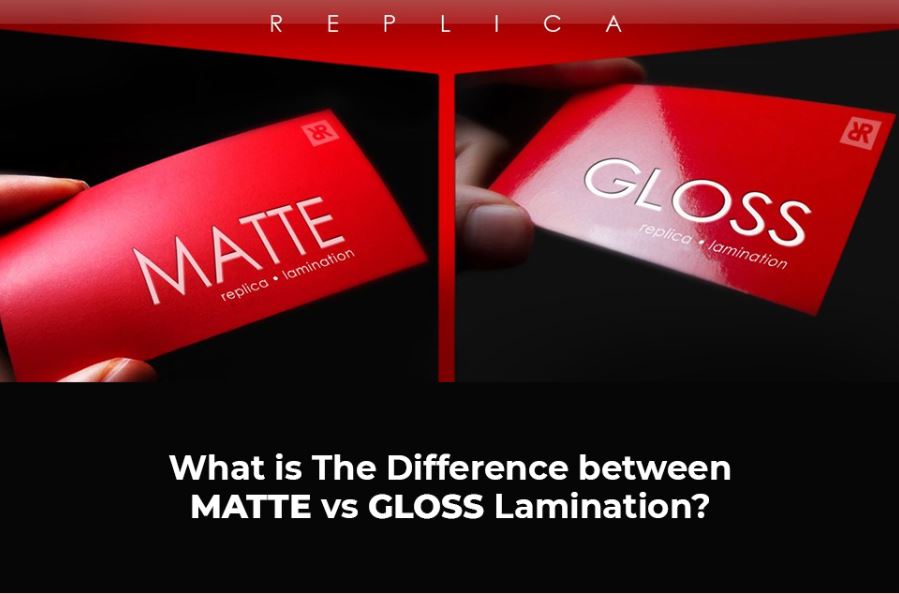
The two most common visual options are matte lamination, which produces a subdued finish, and gloss lamination, which creates a reflective surface.
1. What Is Matte Lamination?
Matte lamination creates a smooth, low-gloss surface that reflects less light directly toward the viewer. It is often selected for premium business stationery, corporate brochures, presentation folders, and minimalist designs.
The reduced reflection can improve readability under certain lighting conditions, particularly when printed materials contain substantial text.
Technical Characteristics of Matte Lamination
Low surface reflectivity: Matte films scatter reflected light more diffusely than high-gloss surfaces, reducing mirror-like reflections.
Subdued colour appearance: Colours may appear softer or less saturated compared with the same artwork under gloss lamination. The actual result depends on the film, ink or toner, paper, and viewing conditions.
Tactile finish: Some matte films provide a smooth, soft-looking surface, while specialty soft-touch laminates create a more distinctive tactile effect.
Fingerprint visibility: Standard matte finishes can make fingerprints less conspicuous than some glossy finishes, although marks and burnishing can still occur.
Readability: Reduced glare can be beneficial for text-heavy printed materials, but readability also depends on typography, contrast, lighting, and the paper beneath the film.
Where Is Matte Lamination Best Used?
Matte lamination is commonly suitable for:
– Corporate business cards and premium stationery.
– Company profiles and business presentations.
– Brochures containing detailed text and graphics.
– Real estate marketing brochures and property presentations.
– Restaurant menus requiring a refined visual appearance.
– Product catalogues and professional reports.
For businesses that want a sophisticated and understated brand presentation, matte lamination is often a practical choice.
2. What Is Gloss Lamination?
Gloss lamination produces a shiny, reflective surface that can make printed graphics appear brighter and more visually prominent. It is frequently selected for marketing materials that rely on colourful photography, bold graphics, and high-impact visual communication.
Its reflective properties can increase the perceived contrast and vibrancy of suitable printed designs, although the actual colour result depends on the printing system and materials used.
Technical Characteristics of Gloss Lamination
High surface reflectivity: Gloss films reflect more light in a concentrated direction, creating a shiny finish.
Enhanced visual impact: Photographs, colourful illustrations, and promotional graphics may appear more vivid because of the surface’s reflective characteristics.
Surface smoothness: Gloss lamination generally provides a smooth, shiny appearance that works well with photographic artwork.
Fingerprint visibility: Fingerprints, smudges, and surface scratches can be more noticeable on some gloss films, particularly under direct lighting.
Glare: Reflected light can interfere with readability when the printed material is viewed at certain angles.
Where Is Gloss Lamination Best Used?
Gloss lamination is commonly suitable for:
– Promotional flyers and advertising brochures.
– Product catalogues featuring high-quality photography.
– Colourful marketing leaflets.
– Retail promotional materials.
– Photo-heavy business presentations.
– Printed displays and selected packaging applications.
For campaigns designed to attract attention through bold colours and strong imagery, gloss lamination can be an effective finishing option.
3. Matte vs Gloss Lamination: Technical Comparison
The best choice depends on the printed product, viewing environment, handling frequency, and intended visual effect.
| Feature | Matte Lamination | Gloss Lamination |
|—|—|—|
| Surface appearance | Subdued, low-gloss | Shiny, reflective |
| Light reflection | Diffuse reflection | Stronger directional reflection |
| Colour perception | Often softer | Often more vivid-looking |
| Glare | Generally lower | Generally higher |
| Fingerprint visibility | Often less noticeable | Can be more noticeable |
| Text-heavy designs | Often a good choice | May produce distracting reflections |
| Photographic graphics | Suitable for understated imagery | Often suitable for vibrant imagery |
| Premium corporate appearance | Frequently preferred | Suitable for bold branding |
| Surface protection | Depends on film and application | Depends on film and application |
| Maintenance | Marks may still appear | Smudges and scratches may be visible |
Important: Neither finish is automatically more durable than the other. Durability depends on the film thickness, material formulation, adhesive quality, lamination process, paper stock, and the conditions in which the printed item is used.
4. Which Lamination Provides Better Protection?
A common misconception is that gloss lamination always provides greater protection than matte lamination, or vice versa.
In practice, protective performance is influenced more by the technical specifications of the laminating film than by its visual finish alone.
Several factors determine the level of protection.
Film Thickness
Lamination films are available in different thicknesses, commonly specified in microns. A thicker film may provide greater stiffness or resistance to certain types of handling damage, but thickness alone does not guarantee superior performance.
The suitable thickness depends on the paper weight, product dimensions, folding requirements, and intended application.
Film Material
Different laminating films offer different levels of flexibility, scratch resistance, moisture resistance, and surface durability. Specialty films may provide additional properties beyond those of standard matte and gloss laminates.
Adhesion Quality
Proper adhesion is essential for preventing bubbling, peeling, silvering, and other surface defects. The paper surface, coating, toner or ink characteristics, and lamination temperature can all influence bonding.
Paper Compatibility
The substrate must be compatible with the selected film and laminating process. Some paper coatings and heavily printed areas may require additional testing to ensure reliable adhesion.
Handling Conditions
Business cards carried in wallets, menus used frequently in restaurants, and brochures distributed at outdoor events experience different types of wear.
For frequently handled materials, the complete specification should be selected according to the expected environment rather than relying on the matte or gloss label alone.
5. How Does Lamination Affect Colour Accuracy and Print Quality?
Lamination can change the way colours appear because the film alters how light interacts with the printed surface.
Gloss lamination often increases apparent colour depth and contrast by creating a reflective surface. Matte lamination diffuses reflected light, which can make the same colours appear less intense.
These effects are particularly noticeable in photographs, dark backgrounds, gradients, and saturated brand colours.
For accurate and consistent results, consider the following factors:
Colour management: Artwork should be prepared using the appropriate colour workflow and printer specifications.
Paper selection: Coated and uncoated stocks can produce different colour and contrast characteristics before lamination.
Print technology: Toner-based and inkjet printing systems may respond differently to particular films and adhesives.
Proofing: A physical sample can reveal how the selected paper and laminate affect the final appearance.
Brand consistency: Businesses using specific corporate colours should evaluate the finished laminated sample rather than approving artwork solely from a computer screen.
When colour accuracy is critical, testing the complete combination of printing method, paper, and laminate is more reliable than selecting a finish based on appearance alone.
6. Can Matte or Gloss Lamination Be Written On?
Standard matte and gloss laminating films are generally not designed to behave like uncoated paper. Their plastic surfaces can prevent ordinary pens, pencils, and some markers from adhering properly.
If a printed item needs handwritten information, signatures, checkboxes, or manual annotations, the surface should be selected carefully.
Possible approaches include:
– Leaving designated areas unlaminated.
– Using a compatible writable laminate.
– Selecting a suitable marker or pen after testing.
– Applying a different finishing method to the writable area.
For certificates, forms, appointment cards, and documents requiring signatures, confirm writing compatibility before approving the finishing process.
7. Which Finish Is Better for Business Cards, Brochures and Menus?
Different printed products have different functional requirements. The most appropriate finish should support both the design and the way the item will be handled.
Business Cards
Matte lamination is frequently chosen for understated corporate branding and reduced surface glare. Gloss lamination can work well for colourful designs and high-impact graphics.
Brochures and Company Profiles
Matte lamination can be suitable for professional reports and text-heavy company profiles. Gloss lamination can be effective for image-rich brochures and product catalogues.
Restaurant Menus
Lamination can help protect menus from routine handling and surface contamination. However, the correct specification depends on cleaning practices, food-service conditions, paper stock, and whether the menu must be frequently wiped down.
Marketing Flyers
Gloss lamination can help bold photographs and promotional graphics stand out. For campaigns containing extensive text or a restrained visual identity, matte may be more suitable.
Presentation Folders
Matte lamination often complements premium corporate branding, while gloss can create a brighter, more reflective appearance.
In all cases, the best finish is the one that meets the practical requirements of the product while supporting the intended design.
8. How Much Does Matte or Gloss Lamination Cost in Dubai?
The cost of lamination in Dubai depends on several variables, including the size of the printed item, quantity, film specification, paper type, printing requirements, and whether lamination is combined with other finishing operations.
Smaller products such as business cards may be priced as part of a complete printing package, whereas larger sheets, brochures, menus, and presentation materials may require different pricing structures.
To compare quotations effectively, businesses should check:
– The finished size and paper specification.
– The type and thickness of the laminate.
– Whether lamination is applied to one side or both sides.
– The quantity and required turnaround time.
– Whether trimming, folding, binding, or other finishing is included.
– Whether a physical proof or sample is available.
For reliable cost comparisons, request quotations using the same paper, dimensions, quantity, and finishing specifications. This helps prevent differences in material quality from being mistaken for savings.
9. How to Choose the Right Lamination Finish for Your Business
Before finalising a printing order, consider the following questions:
1. Does the design contain mostly text, photographs, or bold graphics?
2. Will the printed item be viewed under bright lighting?
3. Is a premium, understated appearance or a glossy, colourful appearance more suitable?
4. How frequently will the item be handled?
5. Does it require handwriting, folding, or repeated cleaning?
6. What level of scratch resistance and surface protection is required?
7. Does the laminate work with the selected paper and printing technology?
If the answers are unclear, request a sample using the intended paper and finishing materials. Examining the physical result under realistic lighting conditions can help you make a more informed decision.
Get Professional Printing and Lamination Services in Dubai
Choosing the correct lamination finish is an important step in producing professional printed materials. Matte lamination offers a subdued appearance with reduced glare, while gloss lamination provides a shiny surface that can enhance the visual impact of colourful designs.
Neither option is universally better. The right choice depends on the design, material specifications, handling requirements, and intended use of the finished product.
StarBay Print Centre offers printing and related finishing solutions for businesses and individuals seeking professional printing services in Dubai. Whether you need business cards, brochures, flyers, company profiles, or other printed marketing materials, selecting the right combination of paper, printing technology, and lamination can help achieve the desired result.
For your next printing project, compare matte and gloss samples before placing the final order to ensure the finish matches your brand identity and practical needs.